Extended-Body PE Fittings: Structural Advantages in Buried and Trenchless Applications
- Share
- publisher
- RUBR
- Issue Time
- Mar 3,2026
Summary
Extended-body PE fittings are designed with a longer fusion section to enhance joint strength, sealing reliability, and installation tolerance. Compared to standard fittings, they offer improved pull-out resistance and better adaptability to buried and trenchless pipeline systems, making them suitable for water supply, gas distribution, and irrigation applications.
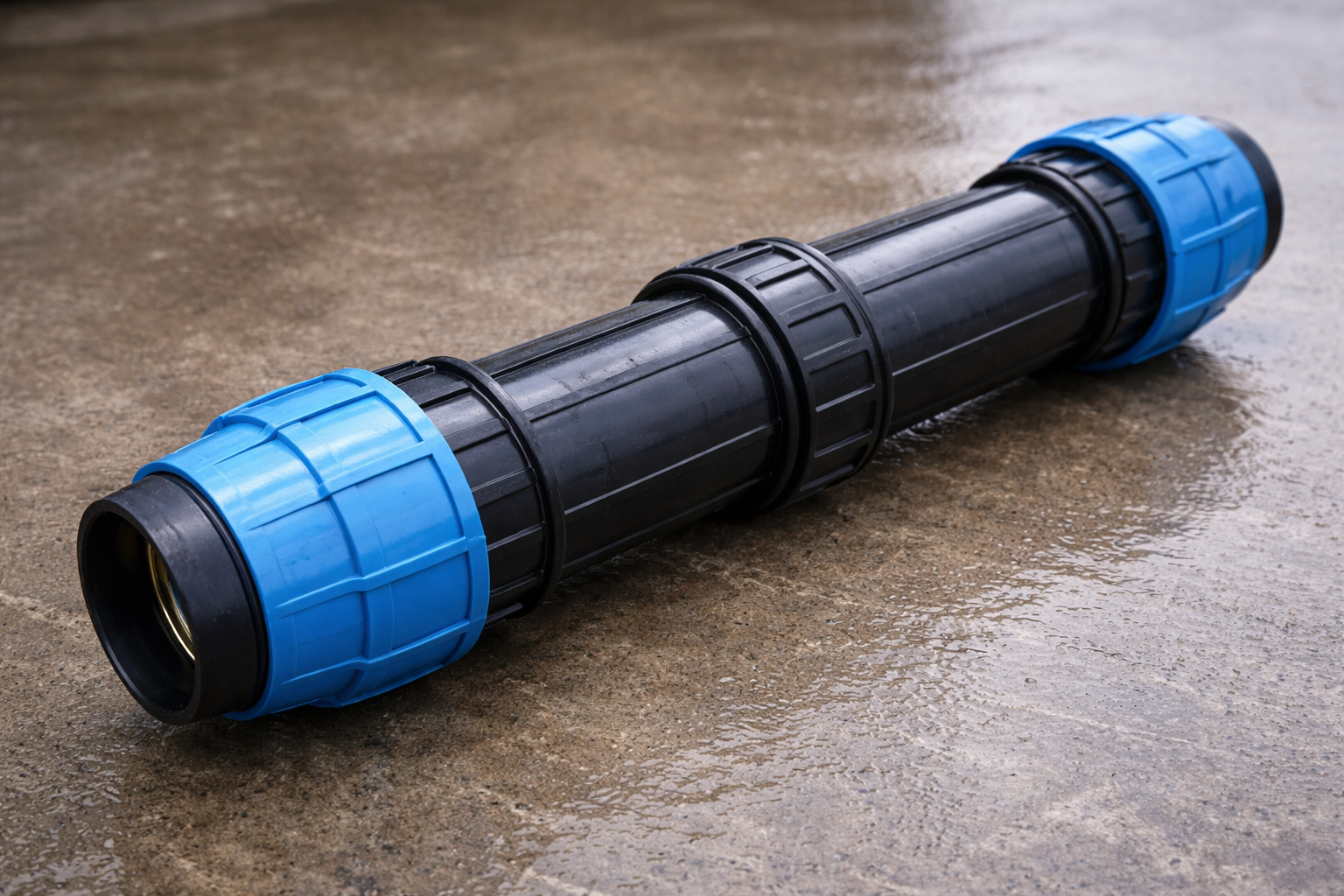
Extended-Body PE Fittings (also known as Long-Spigot PE Fittings) are designed with an elongated socket or fusion section compared to standard PE fittings. The main advantages focus on installation reliability, joint stability, sealing performance, and adaptability.
They are widely used in municipal water supply and drainage, gas distribution, agricultural irrigation, and other PE pipeline systems—especially for buried installations, trenchless projects, and demanding jobsite conditions.
Below are six key benefits explained clearly:
Below are six key benefits explained clearly:
The extended socket provides a longer insertion length, significantly increasing the contact area between the pipe and the fitting. During butt fusion or electrofusion, the larger fusion interface allows more complete material bonding.
After cooling, the joint delivers superior pull-out and torsional resistance compared to standard fittings. Even under soil pressure, ground settlement, or internal flow impact, the connection remains stable and resistant to loosening or separation.
2. Improved Sealing Performance, Lower Risk of Leakage
Leakage in PE systems most commonly occurs at the pipe-to-fitting joint. With an extended fusion zone, long-body fittings create a wider and longer fusion band after welding.
This enhanced sealing interface provides better resistance against water or gas migration along the joint, making these fittings particularly suitable for high-pressure water supply and gas transmission applications where sealing integrity is critical.
3. Higher Installation Tolerance, Easier for Field Crews
Standard PE fittings often have short insertion depths, requiring precise alignment and insertion control. Any deviation may compromise joint quality.
The longer socket of an extended-body fitting offers greater insertion allowance. Even if there is minor deviation in positioning or depth, sufficient fusion contact can still be achieved, reducing installation errors and improving overall construction efficiency—especially helpful for less experienced operators.
4. Better Suitability for Trenchless and Deep Burial Projects
In municipal works, pipelines are frequently installed using trenchless methods or buried at significant depths, where they are subjected to lateral soil pressure and tensile stress.
The longer connection section helps distribute external forces more evenly and reduces stress concentration at the joint. This minimizes the risk of cracking under compression or pull loads, making extended-body fittings ideal for deep burial and complex soil conditions such as soft clay or gravel.
5. Greater Tolerance for Pipe Cutting Variations
On-site pipe cutting may result in slightly uneven ends or minor length deviations. With standard fittings, this often requires re-cutting or adjustment.
The extended socket can accommodate small dimensional variations without compromising joint integrity. This reduces material waste and saves valuable installation time.
6. Lower Long-Term Maintenance, Higher Durability
After installation, the extended fusion zone creates a more integrated joint structure with fewer localized weak points.
In buried environments, the joint is better able to withstand groundwater exposure, soil movement, and microbial activity. Over time, the aging rate at the connection is slower, reducing maintenance frequency and long-term replacement costs—particularly in outdoor buried systems.